
Operation Bloody Fjords Eyewitness Account: Team 5
- Archive- Sea shepherd UK
- Nov 12, 2017
- 6 min read
📁 Archive Document — Historical Record
This article was first published when our charity's original name/branding as 'Sea Shepherd UK' prior to our name change on 18th May 2023 following the removal of Captain Paul Watson from Sea Shepherd entities worldwide (with the exception of the UK, France and Brazil).
Captain Paul Watson remains a member of our Board, and our charity continues to uphold its founding principles of non-violent direct action marine conservation.
This article and its contents are the property of the 'Captain Paul Watson Foundation UK' and forms part of our 21 year history.
Learn more at paulwatsonfoundation.uk/new-name
As part of our ongoing Operation Bloody Fjords campaign to end the slaughter of dolphins and pilot whales in the Danish Faroe Islands, the Captain Paul Watson Foundation UK coordinated ten weeks of covert land-based patrols from July to early September. Centrally coordinated by the Captain Paul Watson Foundation UK, the crews were based in six different Faroese towns covering 19 designated whaling bays. During the ten weeks our volunteer crew, who used their personal vacation time to blend in with other tourists, managed to document nine separate grindadráp. We are now sharing the personal accounts of six of these teams and the images they recorded, one each day for six days.
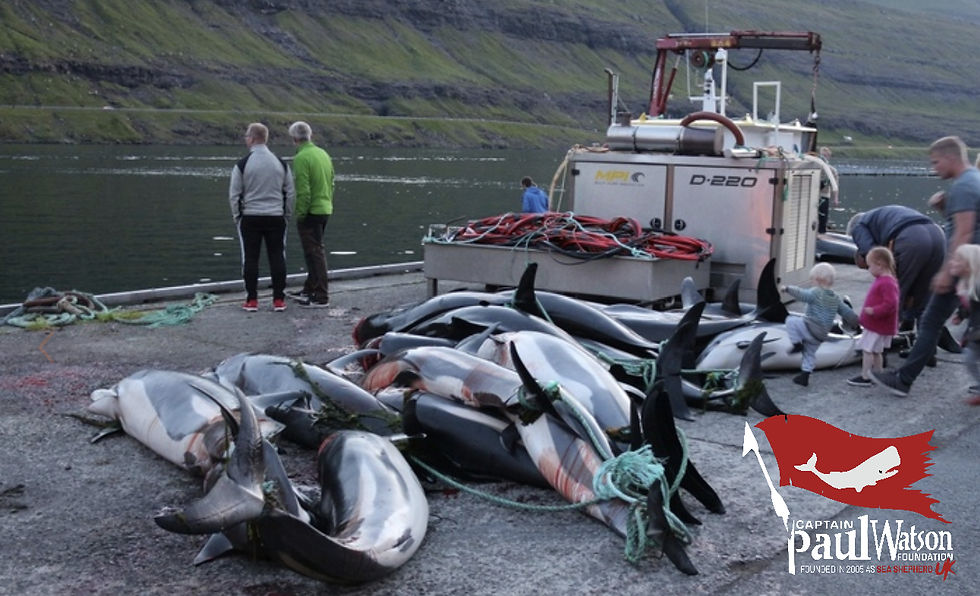
Team 5, based in Saltangará, witnessed the Funningsfjørður hunt on 5th August 2017 (133 Atlantic white-sided dolphins killed) and the Hvannasund hunt on 6th August 2017 (39 long-finned pilot whales and 1 white-sided dolphin killed).
"At 21:00 on the evening of 5th August, reports started to emerge on national websites of two drives: one in Funningsfjørður reporting a pod of 100 dolphins, and the other a pod of pilot whales being pushed toward Hvannasund. The pod of dolphins was driven quickly into the designated killing bay of Funningsfjørður and the entire family slaughtered within minutes of the grind being announced on the national news sites. News that the pod had been slaughtered reached us as we approached the bay. As we drove toward it, we passed in excess of 20 cars leaving the area; many appeared to have whole families aboard as they were leaving the bay. Approaching the bay itself, we could see many people still gathered on the hillside, peering down into the bay as they laughed and joked amongst themselves, children running and playing in the grass. As we joined the groups we began to see the bloody scene below — the sea had already turned red with the blood of over 100 dolphins that had been killed.
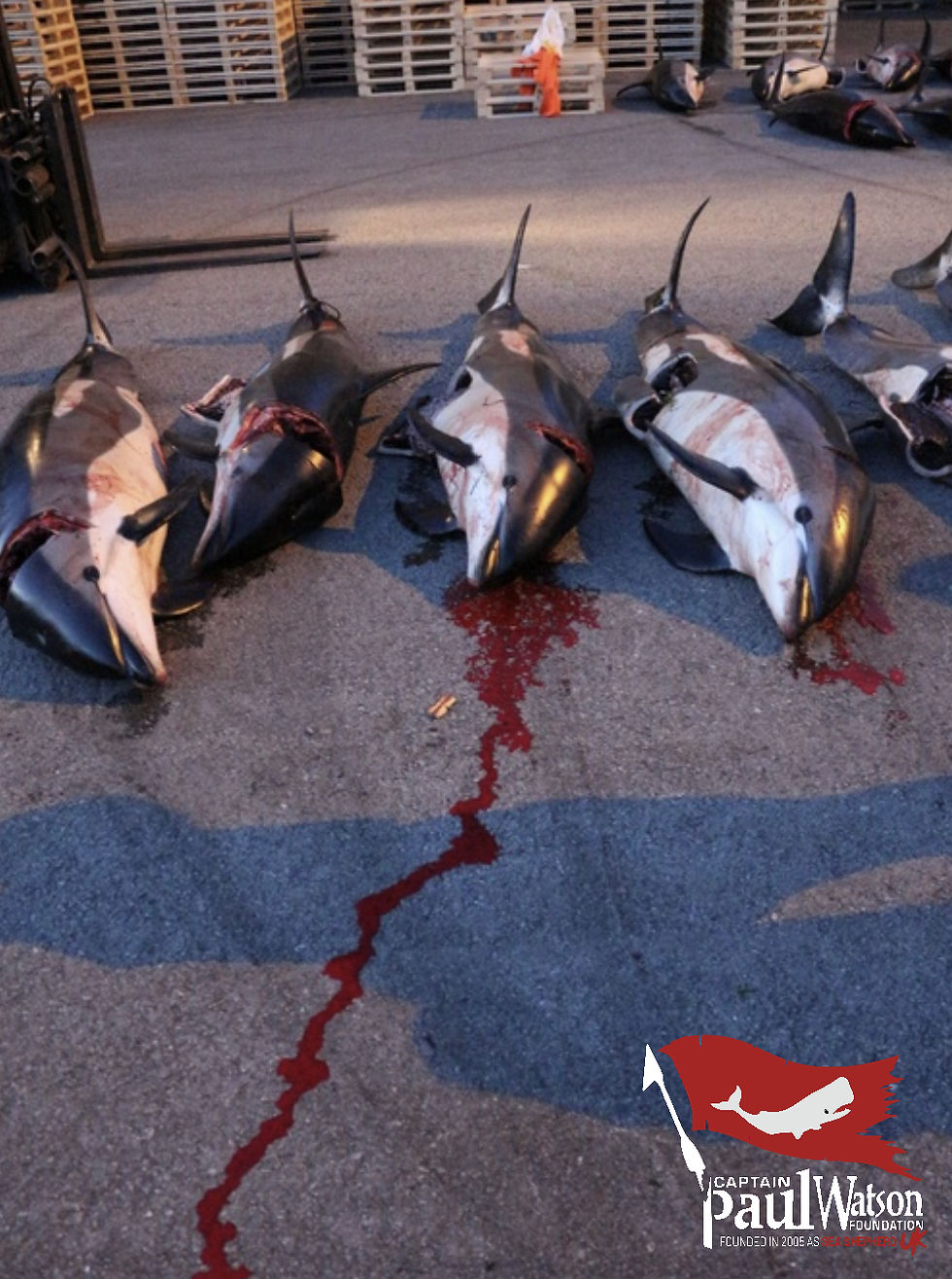
Thoughts immediately turned to the disconnect between the image of people laughing, children playing, and the barbaric scene before us at the water's edge. Many of the pod still lay on the beaches, blood flowing from the kill wounds; one dolphin with a wound so deep it had almost severed the head completely. Parents could be seen taking their children down to see the bodies close up; one we observed even lifting their boy up to sit on the body of a dolphin as they took photos of him. The lack of any empathy for the lives that had just been brutally taken was clear, as was an insight into how future generations are already being exposed to this brutal act. Small boats were still heading away from the bay, returning to the harbour nearby. Watching on, we could see some had dolphins onboard, some with lifeless bodies tied to the side of the boats, while those aboard could be seen securing the metal poles onto the side of the boats — poles that a short time earlier had been used to create a wall of sound to drive the pod into the bay in a state of fear. At the harbour, we could see that the dolphins that had already been moved were not immediately transferred on land; row after row had been leashed to the side of the dock, waiting to be lifted from the water. As we stood watching and taking photos of the horror before us, the sound of metal on metal grew in volume and intensity; looking toward the fjord, we could see that another pod had been spotted and were being driven toward the bay. Small in number, the pod was fighting to evade the boats. The struggle continued for only a matter of minutes (though the bay is far inland, so it will have been ongoing for much longer) before the boats turned away and the pod escaped as the light began to fade. In the harbour, a group had started to form close to the tethered dolphins — as is tradition for a grind, those present register with the grindmaster to secure their skinn (the term relating to the allocation of meat the family will receive). We watched as body after body was pulled from the water. Initially the dolphins were merely pulled out and left as those involved pulled more bodies out. It became clear that to those in attendance this was an entertaining event; speaking to and listening to the groups, we were appalled to hear people refer to the cruel slaughter as fun. What was unusual was that at times there appeared to be an element of confusion and lack of plan for how to process the dolphins, given that those actively involved are experienced and certified to participate. Bodies were dragged to locations to line up, then moved again when it became clear there were more dolphins still in the water. It appeared they did not actually know how many they had just slaughtered (as seems to be the case — the final numbers were not announced for many days afterward).
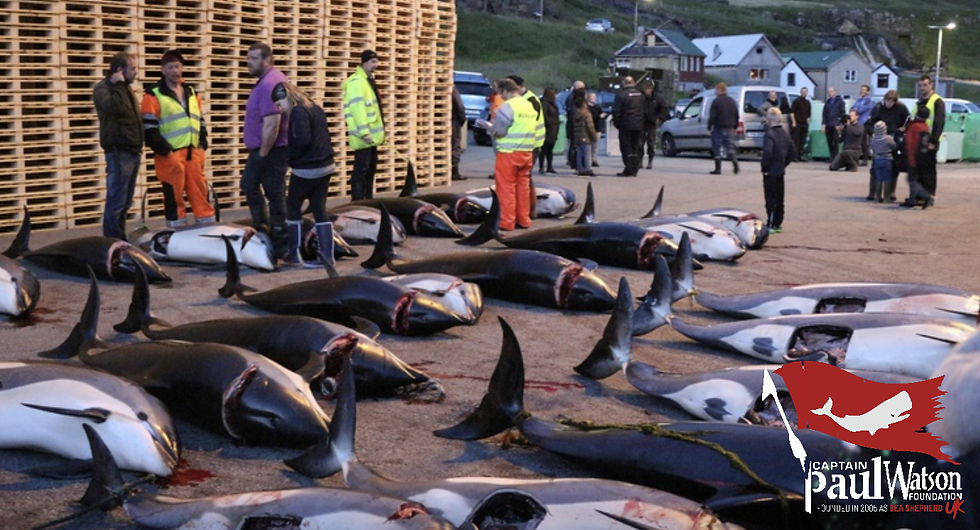
Of the numerous cruel actions witnessed at Funningsfjørður, the image of dorsal fins being removed and handed to children to run and play with on the dock amongst the bodies of over 100 dolphins will be one that remains; as will witnessing a juvenile, no more than 1–2 feet in size, being rushed from the dock and hidden/guarded in a box away from those watching and away from the official count. Mothers, babies and juveniles — none are spared from the butchering, but some were clearly spared from the official count. As darkness fell, such was the level of confusion over final numbers that divers were, unusually for the time and level of light, sent into the water to search. As we left the harbour, there were 107 dolphins, though the final figure announced was 133. Odd that trained and certified participants would lose 26 bodies that the divers no doubt had to locate. Locals were clearly wary of any campaign presence, asking unfamiliar faces if they were there to document the hunts. Such is the impact of anti-grind operations that even when no active campaign is announced — no boats on the horizon — the Faroese are still mindful of it. On the morning of 6th August we travelled to Klaksvík following reports that the pilot whales killed on the previous evening would be butchered and distributed to participants of the grind that morning. As we approached the harbour at 7am the pod could be clearly seen on the docks, with a group of people already gathering. As we got closer, we could see that the grindmaster was talking to those present via a microphone; as is usual following a grind, he is responsible for the allocation of skinns. While this was continuing, we approached the bodies of those brutally killed the night before, steam rising from them, still warm despite being killed several hours earlier. Notably, numbers had already been carved into the heads of the pilot whales, as is done to identify the number of skinns that can be butchered from each body. As the grindmaster called names, people stepped forward to collect paperwork confirming their allocated pilot whale.

Showing that this was less about tradition and more about community blood sport, a number of certified participants were seen drinking alcohol whilst holding large sharp knives ready to commence the butchering. Hvannasund grind participants are clearly much more experienced, having completed a number of grinds already in 2017; the speed at which the butchering process progressed was shockingly efficient. First the pilot whale was skinned, and the outer layer of skin and blubber used as a sheet on which to lay the meat as it was unceremoniously carved from the bodies. Strange, the level of care given to keep the meat from being tainted with dirt — yet the level of mercury contamination within the meat was not a cause for concern at all. Again, participants were laughing, drinking and smoking as they 'processed' the bodies, with no sign of acknowledging that the body before them was once a sentient and intelligent being that had been terrorised and slaughtered the previous evening."
2017 has proved to be one of the worst years for the grindadráp since the mid-1990s, with 1,203 pilot whales and 488 dolphins killed during 24 individual hunts in the Danish Faroe Islands.
Check back tomorrow for the next report and images from Team 7.


Comments