
Ripples of Change — The Maremnants
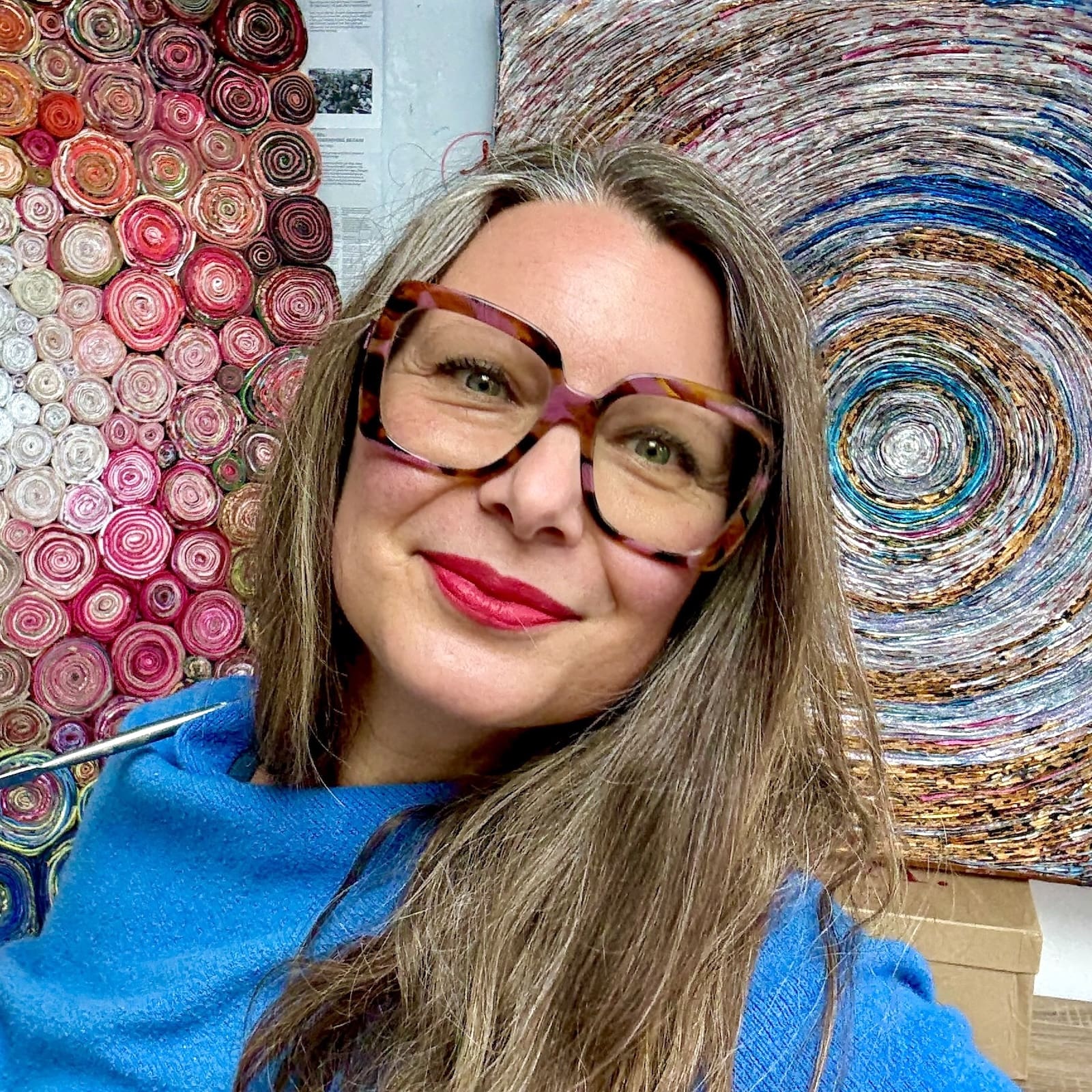
I feel proud and lucky to be a part of Project One Wave.
It was within this framework that Ripples of Change was born. Hosted for one month at Britton Scotland in Dornoch, the exhibition grew from a collaboration with Amy Britton, a fellow member of Project One Wave. Although the exhibition has now ended, the movement it represents continues — and so does our partnership

Ripples of Change showed works from The Maremnants, a series that exists because of this network — shaped by its missions, its people, and the materials it rescues. These artworks are created from what our marine industries leave behind: ghost gear, fishing waste, ropes, nets, and fragments of a system that has forgotten its own impact. In the exhibition, industry waste collected by Amy through Forth Ports was transformed into textured abstractions echoing Scotland’s seagrass beds, mossy glens, tidal movements, and coastal forms.
They imitate nature while exposing how deeply synthetic waste has infiltrated it. Each piece becomes a quiet protest against disposability and a reminder of how closely beauty and damage now coexist.
My art is not a solution to plastic pollution — it cannot clean the oceans or dismantle harmful systems — but it can help people understand. Art is the closest thing we have to a universal language: it bypasses defensiveness, bridges worlds, and reaches people who might otherwise never engage with a scientific report or policy document. Art creates awareness and connection — the shift in perception and spark of empathy from which change begins.

Ripples of Change was built on this principle. Each artwork mirrors the ripple created when something from the land world enters the marine one, each penetration offering a glimpse into a realm we rarely see. Familiar objects — dental floss, shell casings, plastic fragments from daily life — are deconstructed into underwater worlds that feel strangely recognisable, inviting curiosity, empathy, and a renewed sense of care, encouraging us to reconnect with what we have forgotten and to recognise what we are losing. And just like ripples on the water’s surface, these works extend outward exponentially by enabling conversations, connections, and inspiring action.

These pieces also reveal that waste has intrinsic value, because every fragment has already absorbed countless resources, processes, energies, and human hands. It deserves respect, not disposability. Every piece I make is created from what I call trashure — materials that already exist, have a value, and hold the potential to be transformed rather than extracted anew. When this understanding is shared across a network, it becomes far more powerful, and Project One Wave provides the structure that allows individual insights to contribute to a wider movement, hopefully making a tangible difference in sustainability within the art world as well.
More importantly, this series is deliberately accessible. These are entry‑level artivist pieces, priced at one quarter of their market value, because activism must be reachable. Artivism should never be a luxury; it should be a catalyst for awareness, reflection, and responsibility. By making these works accessible, I hope to widen the circle of people who feel connected to the cause that Project One Wave represents.

In addition, five per cent of every sale goes to CPWF UK, supporting the protection and restoration of the waters that sustain us all. Their work is vital, and I am honoured that the Maremnants can contribute, even in a small way, to their mission. The exhibition may be over, but do not worry — you are still in time to play your part. By welcoming one of these small artworks into your home, you help keep the ripple moving, extend the conversation, and carry this shared movement into your own circle — and beyond.
This collaboration is the first of many I already have brewing within this movement, and The Maremnants are simply my first contribution to that shared effort — small works, but meaningful emblems of a much larger movement towards protection, responsibility, and hope.

Francesca Busca is an Eco‑artivist by mission, a Rubbish Artist by identity, and a Waste Mosaicist by technique. Her practice sits at the intersection of art, activism, and environmental urgency, transforming society’s discarded materials into catalysts for systemic change. A former City solicitor who shifted to art in 2015, she pioneered a practice made entirely from waste — her “trashure.” Having lived across Italy, England, France, and the USA, she draws on a broad cultural lens to inform work rooted in global awareness and local engagement.
Graduating with distinction from the London School of Mosaic in 2019, she sources materials through community networks and activist missions, recontextualising them into urgent commentary on ecological collapse. Her “trashure” — from hairdresser foils to plastic bottles, medicine vials, and fruit nets — is donated by communities of all sorts, enabling collaborative artworks that dismantle disposable culture and reveal the intrinsic value of refuse. Her eco‑artivism extends into daily life through veganism, renewable energy, second‑hand living, and ethical material limitations, forming a holistic Gesamtkunstwerk.
She uses art as a universal language to spark empathy for life in all its forms and to encourage a systemic shift from anthropocentric to holistic. In collaboration with the Critical Accounting Reading Group from Birmingham Business School, she is researching the role of art as both vessel and subject of a transition from profit‑driven systems to nature‑aligned ones. Her practice also challenges aesthetic and economic hierarchies through unconventional methods and alternative models such as Payment in Kind(ness)© and ArtforTrash©, reshaping how the art world defines value. Her work is exhibited, awarded, published and collected internationally. She contributes regularly to Person and Planet (USA) and Blognotes (Italy), and she is a member of IOAEA, ActforEaling, BAMM, ArtCan, VAA, and Mensa. She is frequently called upon to deliver eco-artivist talks across all sectors of society—from schools to corporate environments, she collaborates with the London Transport Museum and the Institute of Marine Sciences in Venice CNR-ISMAR (part of the National Research Council), and is a partner of the London Clean Air initiative.
She is also the founder of the international eco‑activist collective GREENy bastARTs, with whom she is currently developing KINDFIRE, a 10‑day eco‑artivist exhibition for London Climate Action Week 2026 at The Building Centre, addressing six environmental urgencies through art, events, workshops, and expert panels, and enabling participants to leave with tangible actions for a kinder planet.

This article is very well written and reads pleasantly from start to finish. Each section adds relevant information without being repetitive. I printed some parts to have them available while working. It is an interesting resource for anyone wanting to understand this topic better.