
Sea Shepherd (Now known as Captain Paul Watson UK) Launches 14th Campaign Against Pilot Whale and Dolphin Hunts in Faroe Islands
After one of the worst years for dolphins in the Faroe Islands in history, the Captain Paul Watson Foundation UK's determination to end the grindadráp now intensifies with a significantly upscaled 14th campaign year — our 7th consecutive year operating on the ground in the Faroe Islands. The new campaign will use new resources, more volunteer crew on the ground for longer than ever before, and experienced media teams embedded for the entire campaign.

Adapting Our Tactics
Captain Paul Watson and the organisation he founded, Sea Shepherd, were the first activist group in the Faroes in 1983, with further direct-action campaigns in 1985, 1986, 2000, 2011, 2014 and 2015. Then, due to vessel restrictions directed at Sea Shepherd as well as new Faroese legislation preventing interventions from any activists against the grindadráp, Sea Shepherd UK launched Operation Bloody Fjords in 2017 as a land-based investigative and documentation campaign. That campaign has since been continued and expanded by the Captain Paul Watson Foundation UK, with volunteer crew sent to the islands every year to investigate, document and expose the barbaric hunts to the world, and to bring pressure on the Faroese to end the grindadráp.
Our crew have been instructed since 2017 to make sure they film and photograph the killing of Atlantic white-sided dolphins, which the Faroese media, their tourism board Visit Faroe Islands, and their government have actively suppressed — with few images and no video published. To make this point, our Operation Bloody Fjords logo was designed with both a pilot whale and an Atlantic white-sided dolphin.
Volunteer crew over the years 2017 to 2021 have documented 47 grindadráp hunts, including 13 in which Atlantic white-sided dolphins, Northern bottlenose whales, or bottlenose dolphins were killed. Video and hundreds of images are now freely available to the media, with many also published on the campaign's portfolio page.

The Video That Shocked the World
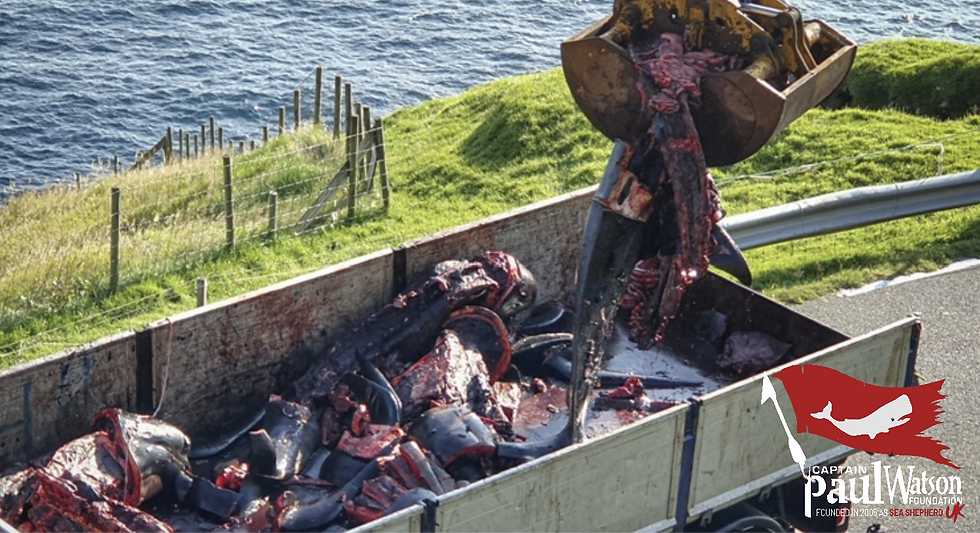
The most recent Atlantic white-sided dolphin hunt, on 12th September last year, was filmed by a Faroese crewmember, and the resulting images and video caused international outrage. In that single hunt, a total of 1,428 Atlantic white-sided dolphins were driven 45 km over about five hours by speed boats and jet skis into the shallow waters at Skálabotnur in the Faroe Islands. Every single member of that pod was killed. This hunt was the largest single hunt of dolphins or pilot whales in Faroese history, and is possibly the largest single hunt of cetaceans ever recorded worldwide.
The footage showed many of the dolphins were still alive when they were thrown ashore onto other recently killed members of their family pod. The dolphin massacre was cruel, drawn out, and badly managed by the grind foremen, with animals left suffering and waiting to be killed for far too long. It is no surprise the hunt was criticised publicly in the Faroese media, and even by some outspoken pro-whalers and politicians in the Faroe Islands.
This cruel and unnecessary hunt was carried out towards the end of the summer, when the Faroese had already killed 615 long-finned pilot whales, bringing the total number of cetaceans killed in 2021 in the Faroe Islands to a shocking 2,043.

The Local and International Reaction
Within days, Danish newspaper Ekstra Bladet published interviews with locals, whose full names are redacted for their families' safety, explaining how many Faroese are furious with what happened. "My guess is that most of the dolphins will be thrown in the trash or in a hole in the ground," said one. "We should have quotas per district, and we should not kill dolphins," said another. One local asked Danish Prime Minister Mette Frederiksen to investigate the matter, saying, "If she expresses her criticism, then it will also be easier for the locals who want this barbaric tradition stopped." Others expressed worry that the international press showing the slaughtered dolphins put their exports at risk — the Faroe Islands export salmon to the UK, US and Russia.
Even the local Faroese press, usually reluctant to publish anything against the hunt, quoted Hans Jacob Hermansen, former chairman of the grind, saying the killing was unnecessary.
Four days after the unprecedented dolphin hunt, Faroese Prime Minister Bárður á Steig Nielsen stated: "We take this matter very seriously. Although these hunts are considered sustainable, we will be looking closely at the dolphin hunts, and what part they should play in Faroese society. The government has decided to start an evaluation of the regulations on the catching of Atlantic white-sided dolphins."
Over five months later, Prime Minister Bárður á Steig Nielsen remains virtually silent on the dolphin hunt and his promised review. However, this week the Faroese parliament (Løgting) discussed the matter, though any decision seems to still be weeks away — if indeed any decision is made at all, with many speculating that the Faroese parliament is stalling to see if the international outrage subsides.
Maintaining the Pressure on Multiple Fronts
Together with the London-based impact consultancy Shared Planet and our growing #StopTheGrind coalition, we have been working hard to make sure that pressure on the Faroese only intensifies this year.
Our coordinated multi-pronged strategy has already started, with conservationists, NGOs, politicians, celebrities, lawyers, and commercial stakeholders working to achieve positive change on different aspects of the grind — including working to have future trade agreements with the UK and other nations include a condition that the Faroe Islands no longer kill dolphins and pilot whales.
"The UK and indeed all other nations where dolphin hunts and whaling are already banned must make it clear that they have zero tolerance of the cruel Faroese grindadráp hunts. The pilot whales and other dolphin species killed in the Faroe Islands already face many challenges to their future survival — from climate change, by-catch, overfishing, noise and chemical pollution, lost and discarded ghost fishing gear, plastics in the ocean, and microplastics in their food chain. Ending the killing of hundreds, sometimes thousands of dolphins each year can, unlike the other issues, be achieved almost immediately if the political will exists — and we as citizens must make sure that our politicians act on our behalf, so that our children and future generations can see these magnificent and intelligent species around our shores, and not just as an entry under 'extinct species' in books and on the internet." — Rob Read, Chief Operations Officer, Captain Paul Watson Foundation UK

Growing Opposition Within the Faroes Community
Every year, we encounter more Faroe Islanders who are opposed to the grind, but who feel unable to speak out publicly for fear of reprisals. However, progress is being made — we now have both Faroese crew and other collaborators whose efforts to bring an end to this needless and cruel slaughter of pilot whales and other dolphins we will continue to support and encourage.
During 2021, our crew experienced more support than ever before from Faroese citizens — not only against the grindadráp hunts, but also for other marine conservation work worldwide. This year, our international volunteer crew will do everything we can to engage with and encourage more Faroese citizens.


Comments